The “Sleeping Prophet” and the Atlantis Connection
Nearly a hundred years ago, Edgar Cayce, a Kentucky clairvoyant, proposed a theory that captured the public imagination: the pyramids were built by migrants from the lost island of Atlantis. According to Cayce, these “highly evolved souls” used the power of sound and nature to levitate stones into place.
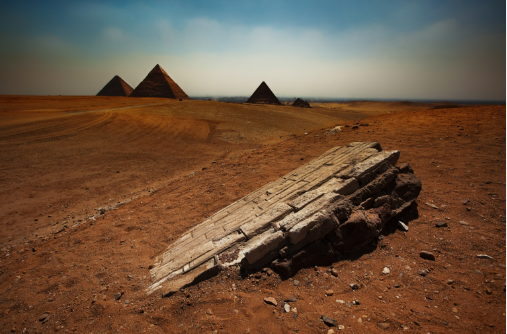 The irony of this narrative is that it inadvertently helped cultivate one of the world’s leading experts on the subject. Cayce’s son, Hugh Lynn Cayce, mentored a college dropout named Mark Lehner, hoping to find archaeological proof of his father’s “Hall of Records” beneath the Sphinx. Instead, Lehner discovered a passion for rigorous, evidence-based research. He evolved from a searcher of fringe theories into one of the world’s foremost Egyptologists, proving that the line between “fringe” and “fastidious” can be bridged in a single career.
Engineering Realities: Concrete vs. Granite
As science advanced, the search for a “simpler” explanation took a chemical turn. Decades ago, French engineer Joseph Davidovits proposed that the pyramids were essentially “cast in place” using a limestone slurry and wooden molds. It was a compelling thought—the ancient equivalent of pouring concrete.
However, the “Potemkin pyramid” theory faced a harsh reality check:
The Physical Evidence: The 2013 discovery of the Diary of Merer documented actual logs of heavy, intact stones being transported downriver.
The Material Hurdles: The vaulted granite slabs inside Khufu’s chamber are undeniable in their natural form and density, rendering the “cement” theory insufficient.
The Rise of the Armchair Engineer
In the age of the internet, a new breed of “pyramid specialist” has emerged: the backyard tinkerer. These individuals, often skeptical of mainstream academic “gatekeeping,” seek to solve the logistics of construction through brute-force pragmatism.
I spoke with one such person, a retired Mississippi newspaperman named Roger Larsen. He was convinced that the academic consensus regarding earthen ramps was flawed—arguing that such ramps would have to be miles long and would have left a significant archaeological footprint.
“If society collapses and we’re back in the Stone Ages, I’m-a be king of the heap,” Larsen told me, sharing his own mechanical designs for stone-lifting devices.
While some of these theories verge on the fantastical—ranging from kite-lift systems to animal-skin flotation devices—there is something undeniably democratic about this movement. They are united by a refusal to accept that the builders of the pyramids were limited by anything other than their own ingenuity.
The Eternal Allure
Whether we are scientists, historians, or simply curious observers, the pyramids hold a unique power over our collective imagination. They are a monument to human ambition, and perhaps the reason they remain so captivating is that they force us to confront the limits of our own understanding.
Pliny the Elder, writing in the first century A.D., dismissed them as “superfluous and foolish displays of wealth.” Yet, even in his criticism, he acknowledged their sheer, impossible presence. Thousands of years later, we are still staring at those same triangles, trying to figure out how they got there, and why we care so much.