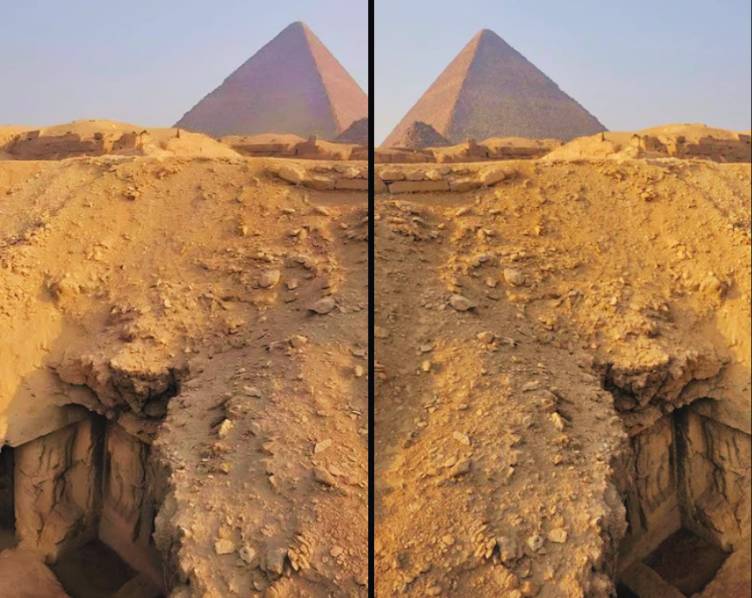
A vivid wall painting dating back more than 4,300 years has been discovered in a tomb just east of the Great Pyramid of Giza. The artwork offers a rare, colorful glimpse into daily life and spiritual beliefs during Egypt’s Old Kingdom (2649–2150 B.C.)—the golden age of pyramid building.
A Surprise Discovery
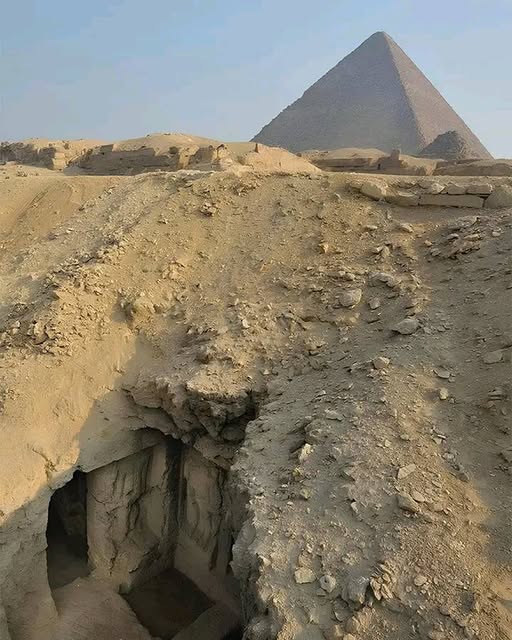
The masterpiece was uncovered by an excavation team from the Institute of Oriental Studies of the Russian Academy of Sciences, which has been studying the site since 1996. Archaeologists stumbled upon the painting while restoring the tomb of Perseneb, an ancient elite who served as a “priest” and “steward.”
While the tomb itself was first recorded by Western explorers in the 19th century, the painting remained hidden for centuries. It was buried under a thick layer of soot, dirt, and pollution—partly caused by the industrial growth of Cairo, and partly because people had actually lived inside the tomb during the Middle Ages.
“Known since the 19th century, the [tomb] could hardly present any new principal features,” said Maksim Lebedev, a professor at the Russian State University for the Humanities. “Therefore, it was a real surprise to discover an Old Kingdom painting on the eastern wall.”
Though only about 30 percent of the original plaster survived, experts successfully traced the remaining fragments to reconstruct the entire scene.
Scenes of Life and Death
The reconstructed artwork serves as a visual story divided into multiple layers, each packed with symbolic meaning:
-
Sailing the Nile: The top of the painting features boats sailing south. Lebedev notes this likely represents Perseneb returning from a pilgrimage or an inspection of his funerary estates. In ancient Egypt, displaying sails going south was a major status symbol.
-
Ancient Agriculture: The lower sections depict a complete agricultural sequence: plowing, sowing, workers driving sheep over seeds, and donkeys laden with sheaves moving toward the threshing floor.
-
Family and Hunting: The painting also portrays Perseneb alongside his wife and their dog. Nearby, a marsh scene shows a man bird-hunting from a boat. This “fowling” activity held deep religious significance, symbolizing rebirth and the taming of chaotic forces.
More Secrets to Uncover
The eastern edge of the Giza plateau contains a vast field of tombs built for private individuals of high rank and power. Because many of these rock-cut chapels were rapidly excavated in the early 20th century without proper documentation, archaeologists believe more treasures are waiting to be found.
The Russian team has already detected indirect evidence—such as unusually smooth walls and leftover paint traces—suggesting that more hidden wall paintings lie beneath the plaster of neighboring tombs.
The partial restoration of Perseneb’s tomb was funded by the Thames Valley Ancient Egyptian Society in the UK. While a few preview images have been shared, the full, high-resolution reconstructions of the painting are set to be published in an upcoming scholarly journal.