Coal miners in Serbia have unearthed the remains of a massive wooden boat, believed to have been used by the Romans to transport supplies to a major frontier city and military base.
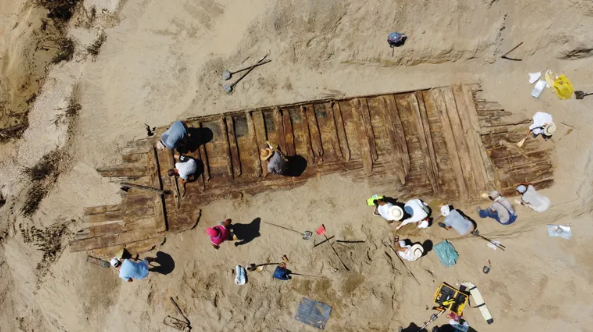 While archaeologists are currently awaiting radiocarbon dating results, preliminary estimates suggest the vessel dates back to the 3rd or 4th century A.D. Experts believe the ship navigated small rivers connecting the Danube River to Viminacium, a prominent Roman city located just a mile (1.6 km) away.
The ancient wreck was discovered in late July at the Drmno open-pit coal mine near Kostolac, approximately 30 miles (50 km) east of Belgrade.
Saved by Mud, Threatened by the Sun
The wooden hull was found buried in a layer of silt about 25 feet (8 meters) beneath the surface. It was exposed on the wall of a cutting after a mechanical digger cleared away the topsoil to reach a coal seam. Recognizing the significance of the find, the miners immediately contacted archaeologists at the nearby Viminacium Archaeological Park.
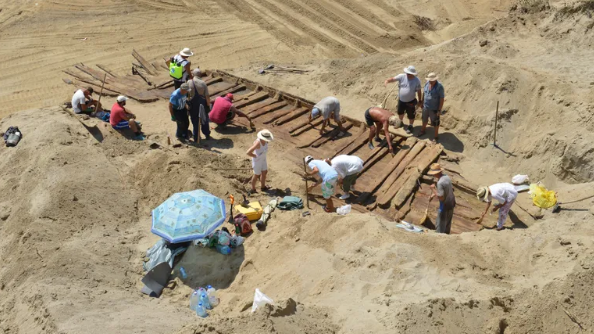 “The wooden boards and the overlying sand were damp, meaning moisture played a crucial role in preserving the vessel,” a spokesperson told the Serbian website Sve o arheologiji.
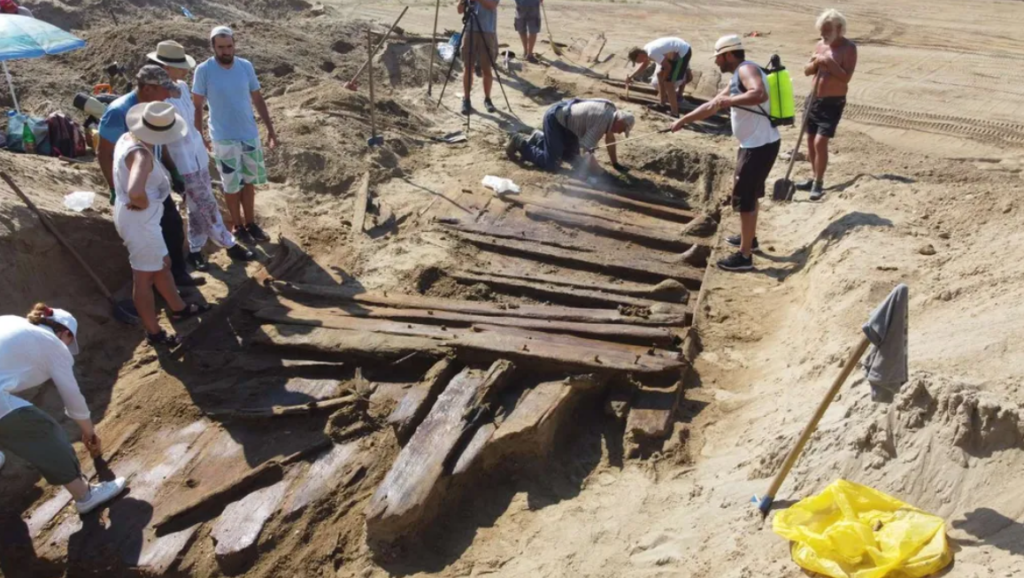
However, excavation brought new risks. “Once unearthed, the bright sun posed a major threat, as it could dry out the timber too quickly,” the spokesperson added. To prevent the ancient wood from rotting or warping, archaeologists continuously doused the remains with water during the recovery process.
A Lifeline for the Frontier
The flat-bottomed barge measured roughly 65 feet (20 m) long and 12 feet (3.5 m) wide. Because of its design, archaeologists believe it was primarily a cargo vessel used for short-distance transport.
“It is likely that the barge was towed from the shore or propelled by oars,” the excavation team noted. “In favorable weather conditions, it could also utilize an auxiliary sail to catch the wind.”
This is not the first time such history has surfaced here. Similar boat remains were discovered nearby in 2020, proving that this area was once a highly navigable backwater of the Danube River.
The Rise and Fall of Viminacium
Established in the early 1st century A.D., Viminacium served as both a civilian settlement and a strategic military fortress. By A.D. 87, it had become the capital of the Roman Empire’s Moesia Superior (Upper Moesia) frontier province.
 With a population reaching up to 45,000 residents, Viminacium grew into one of the largest settlements in the Balkans and a vital trading hub for Roman culture. Multiple Roman legions were permanently stationed at the fort to guard the empire against notoriously hostile tribes to the north.
Its golden age ended in 411 A.D. when the Huns leveled the city and fort, shattering Roman rule across much of Europe. Though rebuilt in the early 6th century by Byzantine Emperor Justinian the Great, it was permanently destroyed in 582 A.D. by invading Avars from the Eurasian steppe.
A Treasure Trove of Artifacts
First rediscovered in the 19th century, Viminacium is now one of Serbia’s premier archaeological sites, even though only a small fraction of the area has been fully excavated.
Over the decades, archaeologists have unearthed tens of thousands of artifacts, including hundreds of gold and silver objects. The site boasts:
-
Richly decorated tombs, palaces, temples, and ancient workshops.
-
Roman baths, paved streets, public plazas, and heavy fortifications.
-
A chariot-racing track and a massive 12,000-seat amphitheater.
The site continues to yield surprising discoveries. In 2021, the remains of at least 13 dogs were found in the ruins of the amphitheater, suggesting the animals may have been used in ancient ritual sacrifices.