The Statue Wept 101 Times With Human Tears — What Mary Warned About 2026 Shocks the World!
In a quiet convent nestled among the forests of northern Japan, one of the most extraordinary and thoroughly investigated supernatural events of the 20th century unfolded in 1973.
What began as a personal spiritual experience for a deaf nun would grow into a series of miracles so compelling that they were officially approved by the Catholic Church, reviewed by Cardinal Joseph Ratzinger himself, and continue to send ripples through the world more than fifty years later.
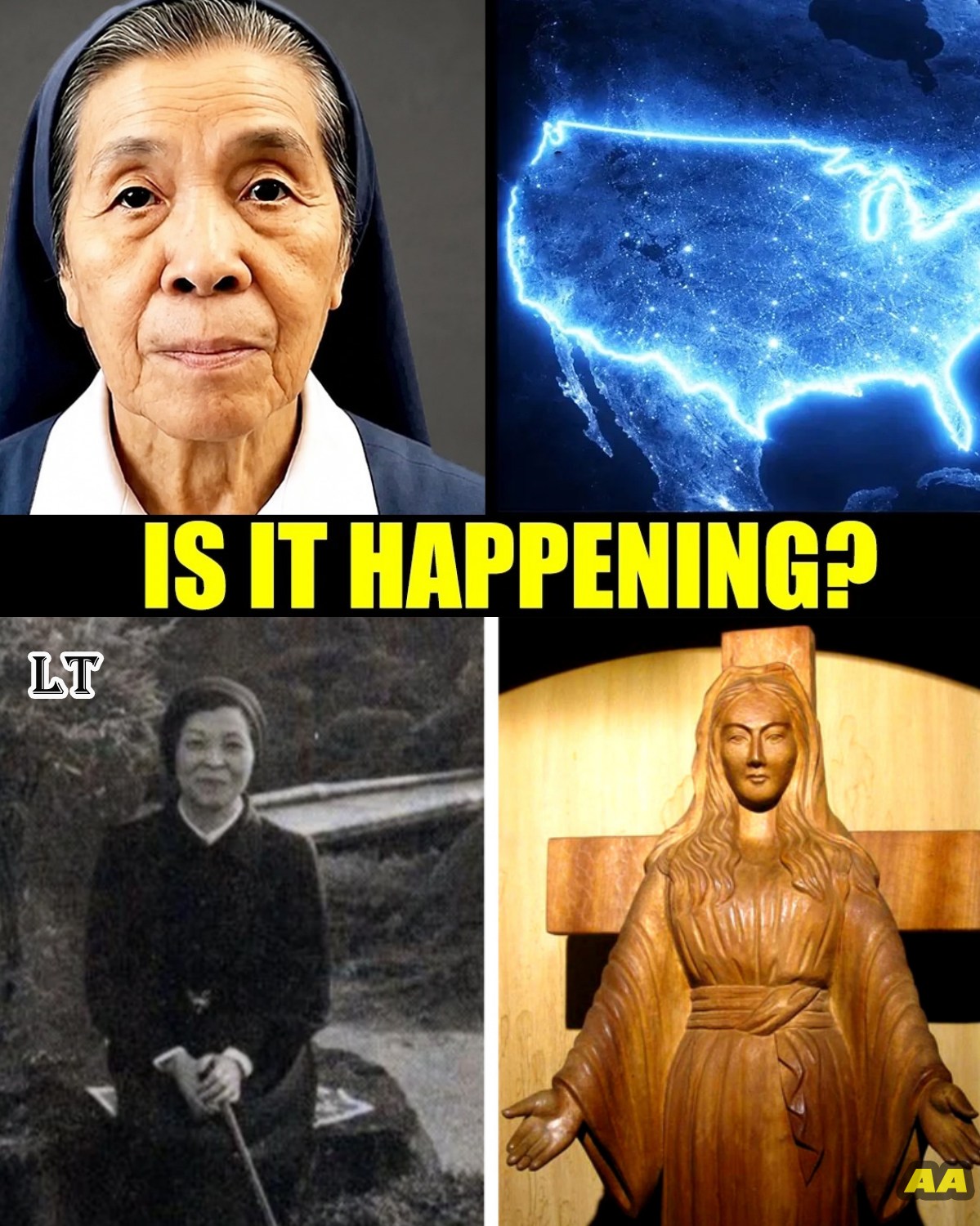
Her name was Sister Agnes Sasagawa.
Born Katsuko Sasagawa in 1931, she barely survived infancy.
At nineteen, a routine appendectomy went catastrophically wrong, leaving her paralyzed from a central nervous system disorder.
Doctors told her she would never walk again.
For the next ten years she lay bedridden, enduring eleven painful surgeries.
During that time, a Catholic nurse brought her water from the Lourdes spring in France.
Shortly after drinking it, Sister Agnes began to recover.
Slowly, miraculously, she regained the ability to walk.
The experience changed her forever.
In 1960, despite coming from a Buddhist family in a country where Catholics made up less than one percent of the population, she converted and took the name Agnes.
She entered religious life and eventually joined the Institute of the Handmaids of the Holy Eucharist in Akita.
On March 16, 1973, at the age of forty-two, Sister Agnes became completely deaf.
Doctors declared her condition progressive and incurable.
Yet just weeks after arriving at the remote Akita convent, something began to happen that would defy every medical explanation.
On June 12, 1973, while praying alone in the chapel, Sister Agnes saw a brilliant light radiating from the tabernacle.
She dropped to her knees, unable to move, held in place by an invisible force.
The light returned the next day, and then a third time while the entire community was present.
Only she could see it.
Then came the stigmata.
On the eve of the Feast of the Sacred Heart, a cross-shaped wound appeared in the palm of her left hand.
It bled.
The pain was excruciating, especially on Thursday and Friday, mirroring the Passion of Christ.
The sisters and chaplain examined the wound.
There was no natural explanation.
A few days later, on July 5, the wooden statue of the Virgin Mary in the chapel began to show the exact same wound on its right hand — bleeding.
The statue had been carved from a single block of wood by a local Buddhist sculptor in 1965.
It was never intended to be anything special.
Now it was weeping tears of blood.
On July 28, the statue itself began to speak to Sister Agnes.
The messages were clear, urgent, and increasingly grave.
Mary spoke of a coming punishment greater than any the world had ever seen if humanity did not repent.
She warned of fire falling from the sky, of survivors envying the dead, and of terrible division within the Church itself — cardinals opposing cardinals, bishops against bishops.
“Only the Rosary and the Sign of the Cross will save you,” the statue told her.
The most chilling message came on October 13, 1973 — the anniversary of the Miracle of the Sun at Fatima.
The Virgin warned that if people did not repent, the Heavenly Father would inflict a punishment so great that no one would be spared.
She spoke of the devil infiltrating the Church and causing confusion at the highest levels.
Then, something even more astonishing began.
Starting in January 1975, the wooden statue began to weep real human tears.
It would happen 101 times over the next six years and eight months.
The tears were collected and tested by leading scientists.
Professor Kaoru Sagisaka, Japan’s foremost forensic expert and a non-Christian, analyzed the samples without knowing their origin.
His conclusion was shocking: the fluid was human blood and tears, but with inconsistent blood types — something biologically impossible for one person.
The local bishop, John Shojiro Ito, conducted a rigorous eight-year investigation.
He interviewed witnesses, examined evidence, and consulted experts.
In 1984, he officially declared the events of supernatural origin.
Cardinal Joseph Ratzinger, then head of the Congregation for the Doctrine of the Faith, reviewed the case and gave his approval.
The apparitions of Akita remain formally recognized by the Church to this day.
Sister Agnes lived quietly in the convent for decades after the events.
Her final message from her guardian angel came in 2019 on the Feast of Our Lady of the Rosary — the same day controversial events were unfolding in Rome.
She passed away on August 15, 2024, the Feast of the Assumption, at the age of 93.
Now, as the world watches increasing global tension, natural disasters, and growing division within the Church, many are revisiting Sister Agnes’s warnings with fresh urgency.
The prophecy spoke of fire from the sky, of internal conflict among Church leaders, and of a time when only the Rosary would remain as a weapon of protection.
Whether one believes in apparitions or not, the story of Akita stands as one of the most scientifically examined and Church-approved mystical events in modern history.
A deaf woman heard heavenly voices.
A wooden statue wept human tears with changing blood types.
A bishop risked his reputation to declare it authentic.
A future pope reviewed and approved it.
And the messages remain as relevant today as they were in 1973.
In an age of uncertainty, the call from Akita is simple yet profound: pray the Rosary daily, repent, make sacrifices, and trust in the mercy of God.
Sister Agnes delivered her final warnings with humility and obedience.
Now it is up to the world to listen.
The tears have stopped.
The voice has fallen silent.
But the message continues to echo across time — from a small chapel in northern Japan to every corner of the earth.