In December 2025, Chief Master Sergeant Ron Lurch, senior enlisted adviser to the Deputy Chief of Space Operations for Intelligence, stood at a podium and delivered an unclassified briefing that mainstream media largely ignored. He did not describe Chinese activity in low Earth orbit as a threat. He called it something more disturbing: a game that has changed.
For years, the cat-and-mouse contest between China, Russia, and the United States played out far above the atmosphere at geosynchronous orbit. That changed in the past year. The new arena is low Earth orbit — specifically the narrow band between 400 and 600 km where the International Space Station (ISS) has housed crews continuously for 25 years.
The game is no longer cat and mouse. It is hide-and-seek.
China has deployed at least three Shijian-series satellites specifically engineered to be nearly invisible to radar. These spacecraft are operating right now at the same altitude as the ISS. The U.S. Space Force tracks them, confirms their maneuvers, and deliberately withholds them from the public catalog at space-track.org. Inside the Pentagon they are known as “analyst objects” — tracked, characterized, but never officially named for the public.
The 18th Space Defense Squadron’s own handbook is explicit: an object’s type is disclosed “when and if” it is entered into the public catalog. Not automatically. Only when someone decides the public should know.
From “Dogfighting” to Stealth at Crewed Altitude
In 2024, five Chinese satellites — three Shijian-24C and two Shijian-6 — performed synchronized, tactical maneuvers in low Earth orbit. Space Force Vice Chief Gen. Michael Guet described the activity at a defense conference as “dogfighting in space,” complete with “tactics, techniques, and procedures” for handing off operations between satellites. The satellites did not appear to be testing navigation or fuel. They appeared to be rehearsing combat.
Then came an even more telling development. In July 2025, China launched Shijian-28B on a Long March 4C rocket into a low-inclination orbit — a profile never before used by the Shijian series. The ISS flies at a 51.6° inclination. A low-inclination orbit crosses the station’s orbital plane twice every revolution, passing through the same altitude band on a predictable, repeating schedule.
The Chinese government called it “space environment exploration.” Space Force analysts noted the obvious: nothing about previous Shijian missions suggested a need for repeated, close-plane crossings with a crewed station unless the environment being explored was the station itself.
Chief Master Sergeant Lurch told the Space Power Conference audience that the three Shijian-24 satellites involved in the 2024 dogfighting exercises each had a progressively smaller radar cross-section. They were not merely maneuvering at ISS altitude. They were learning to disappear there.
The Parallel Catalog No One Talks About
The Space Force publicly lists approximately 40,000 objects in Earth orbit. A second, internal list — the high-accuracy catalog — contains additional objects that are tracked but never published. Some of these “analyst objects” have demonstrated maneuvering capability. Debris does not maneuver. Automated Space Domain Awareness systems are designed precisely to detect such “life changes” and proximity events.
Yet certain objects operating near the ISS orbital regime remain unnamed and unassigned through multiple passes. Commercial tracking firm Leo Labs in Colorado, using its own private radar network, publicly confirmed the reduced radar signatures and maneuvers that the U.S. military would not.
Russian Precedent and the Debris Cover
The pattern is not new. In 2020, Russia’s Cosmos 2543 deployed a subsatellite that fired a high-speed projectile — an event Space Force publicly labeled as weapon-like behavior. The international response was a press statement. China watched and refined the template: smaller radar signatures, tighter maneuvers, and now orbital geometry that intersects the ISS plane repeatedly.
On 30 January 2026, Russia’s primary inspector satellite Luch broke apart, creating a new debris field in the same orbital regime where China’s stealth satellites operate. Debris, conveniently, provides plausible deniability. If something is near the ISS and someone asks what it is, the answer is often “debris” — unless it isn’t.
Silence as Evidence
In November 2021, when Russia destroyed one of its own satellites with an anti-satellite weapon, NASA issued statements within hours, the State Department condemned the test, and emergency UN briefings followed. In March 2025, when the Space Force vice chief publicly confirmed Chinese combat maneuvers at ISS altitude, there was no emergency session, no diplomatic protest, and no NASA statement — only a remark at a contractors’ conference.
The contrast is deliberate. The 2021 response was a public signal that norms still existed. The 2025 response was an internal acknowledgement that those norms had already shifted — and that the public was no longer part of the conversation.
What the Agencies Will Not Say
The ISS is scheduled for de-orbit in 2030. Its commercial successors will operate in the same altitude band. Whatever is being rehearsed today will still be present when the next crewed station launches.
Starlink satellites alone performed 145,000 collision-avoidance maneuvers in the first six months of 2025 — roughly four per satellite per month. Space debris expert Hugh Lewis called the number “incredible” in the sense of “impossible under normal conditions.” Something new in low Earth orbit is generating frequent, precise encounters that even the world’s most advanced autonomous avoidance systems cannot ignore.
NASA continues to speak openly about Martian soil samples and cracked windows on Chinese spacecraft. It has issued no statement on any of the activity described in Space Force’s own unclassified briefings.
The Question No One Answers Publicly
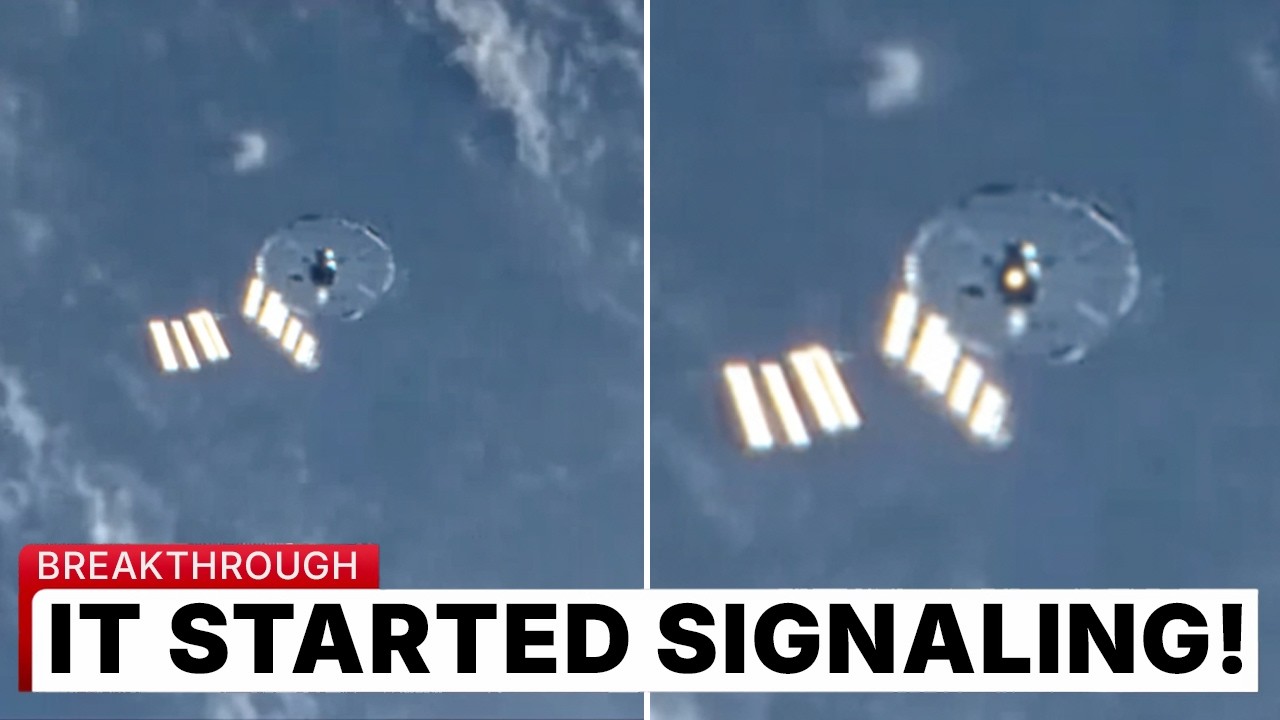
Six astronauts are currently living and working at 408 km, conducting science, growing protein crystals, and photographing Earth. Somewhere in the same slice of space, objects with no public names, reduced radar signatures, and proven maneuvering capability are operating.
The Space Force knows they are there. NASA knows they are there. Both agencies have chosen not to tell the public what those objects are doing when they are within 50 km of a crewed station.
The Outer Space Treaty was written in 1967. It contains no provisions for stealth military satellites practicing proximity operations around inhabited platforms, nor for a parallel catalog of “analyst objects.”
The operational reality has outrun the legal framework. And the institutions responsible for the safety of the crew have decided the public is not ready — or not entitled — to know the rest of the story.
The game has changed. The question is whether anyone outside a classified briefing room still gets to see the board.