The Indonesian archipelago is host to some of the earliest known rock art in the world1,2,3,4,5. Previously, secure Pleistocene dates were reported for figurative cave art and stencils of human hands in two areas in Indonesia—the Maros-Pangkep karsts in the southwestern peninsula of the island of Sulawesi1,3,4,5 and the Sangkulirang-Mangkalihat region of eastern Kalimantan, Borneo2. Here we describe a series of early dated rock art motifs from the southeastern portion of Sulawesi. Among this assemblage of Pleistocene (and possibly more recent) motifs, laser-ablation U-series (LA-U-series) dating of calcite overlying a hand stencil from Liang Metanduno on Muna Island yielded a U-series date of 71.6 ± 3.8 thousand years ago (ka), providing a minimum-age constraint of 67.8 ka for the underlying motif. The Muna minimum (67.8 ± 3.8 ka) exceeds the published minimum for rock art in Maros-Pangkep by 16.6 thousand years (kyr) (ref. 5) and is 1.1 kyr greater than the published minimum for a hand stencil from Spain attributed to Neanderthals6, which until now represented the oldest demonstrated minimum-age constraint for cave art worldwide. Moreover, the presence of this extremely old art in Sulawesi suggests that the initial peopling of Sahul about 65 ka7 involved maritime journeys between Borneo and Papua, a region that remains poorly explored from an archaeological perspective.
 Main
Main
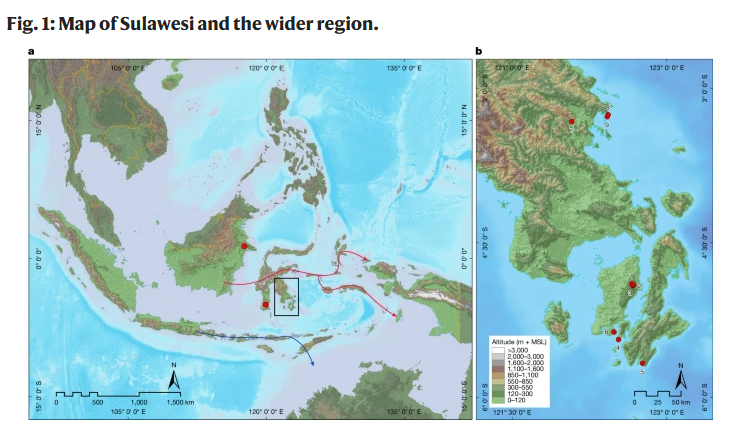
A noteworthy finding of the past decade has been the discovery and dating of Pleistocene-aged rock art in Sulawesi, the largest island in Wallacea—the oceanic island zone separating the continental regions of Southeast Asia (Sunda) and Australia–New Guinea (Sahul)—and on the edge of the Sunda continental shelf (present-day Borneo) to its immediate west1,2,3,4,5,8. In Sulawesi, U-series dating of rock art motifs (n = 23), including hand stencils (n = 13) and figurative paintings of animals (n = 7) and anthropomorphs (n = 3), has yielded minimum ages ranging from 51.2 kyr to 17 kyr (refs. 1,2,3,4,5). All of the dated rock art sites are located in the approximately 450 km2 lowland ‘tower’ karst region of Maros-Pangkep in the southwestern peninsula of Sulawesi. On the opposing southern peninsula, known as Southeast Sulawesi, an area that includes several satellite islands, the presence of rock art inside limestone karst caves was first reported in 1977 (ref. 9). The art in this region, however, has remained underinvestigated compared with Maros-Pangkep art (itself poorly known until recently). Beginning in 2019, we have undertaken a programme of recording and dating of parietal imagery in Southeast Sulawesi, resulting in the documentation of 44 sites (including 14 new localities), and the dating of 11 individual rock art motifs at 8 sites (Fig. 1). The dated motifs comprised seven hand stencils, and four other paintings (two of human figures and two non-figurative, geometric motifs). We used a new method of U-series dating (LA-U-Series analysis) reported elsewhere5 to obtain age estimates for calcium carbonate deposits that had formed in association with these rock art motifs. In all cases, we obtained minimum ages for the parietal images by dating calcite materials that had formed directly on top of the rock art through natural calcium carbonate precipitation. In some instances, we also obtained maximum ages by dating calcium carbonate layers immediately below the pigment layers.
 Rock art dating results
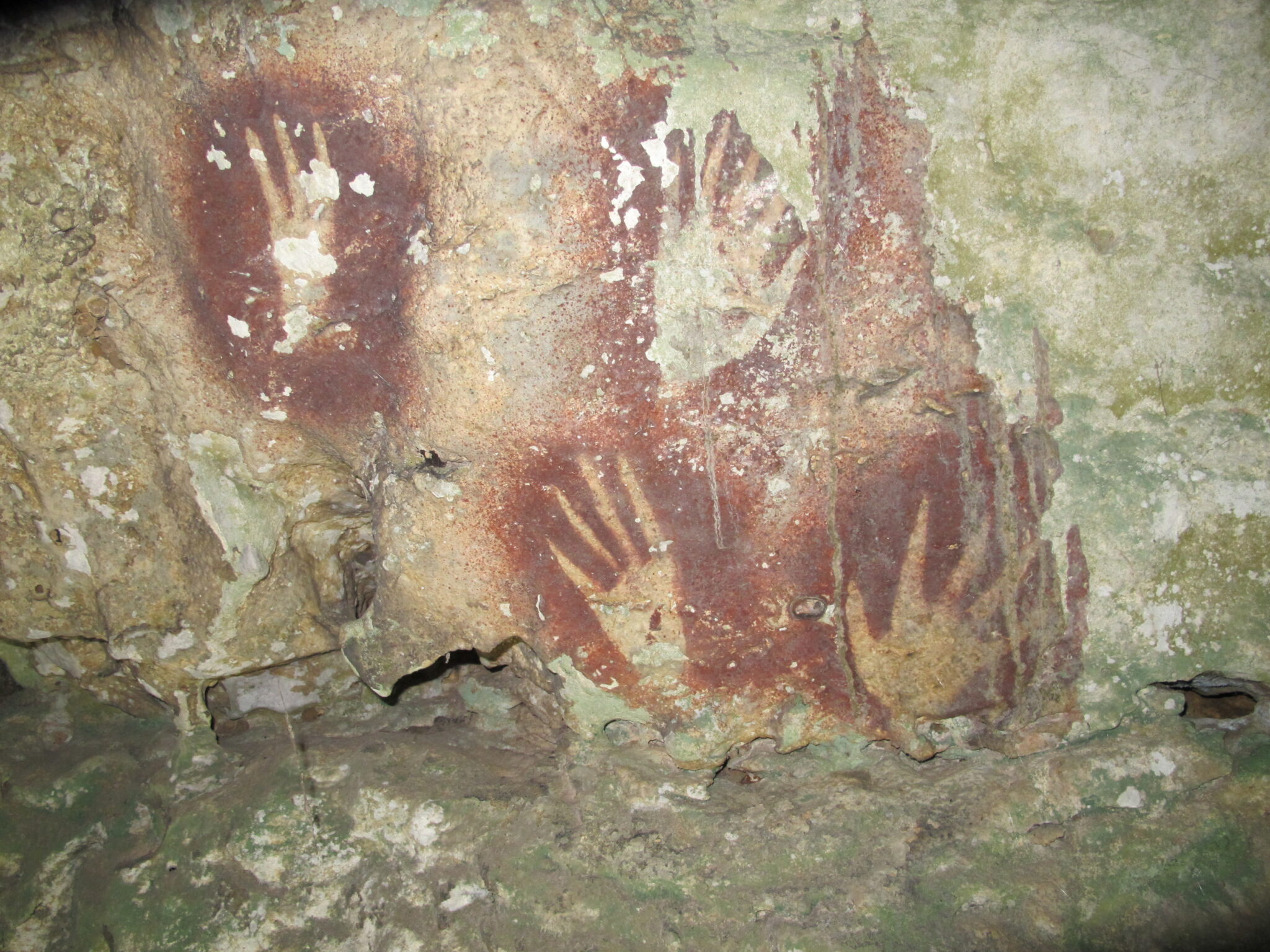
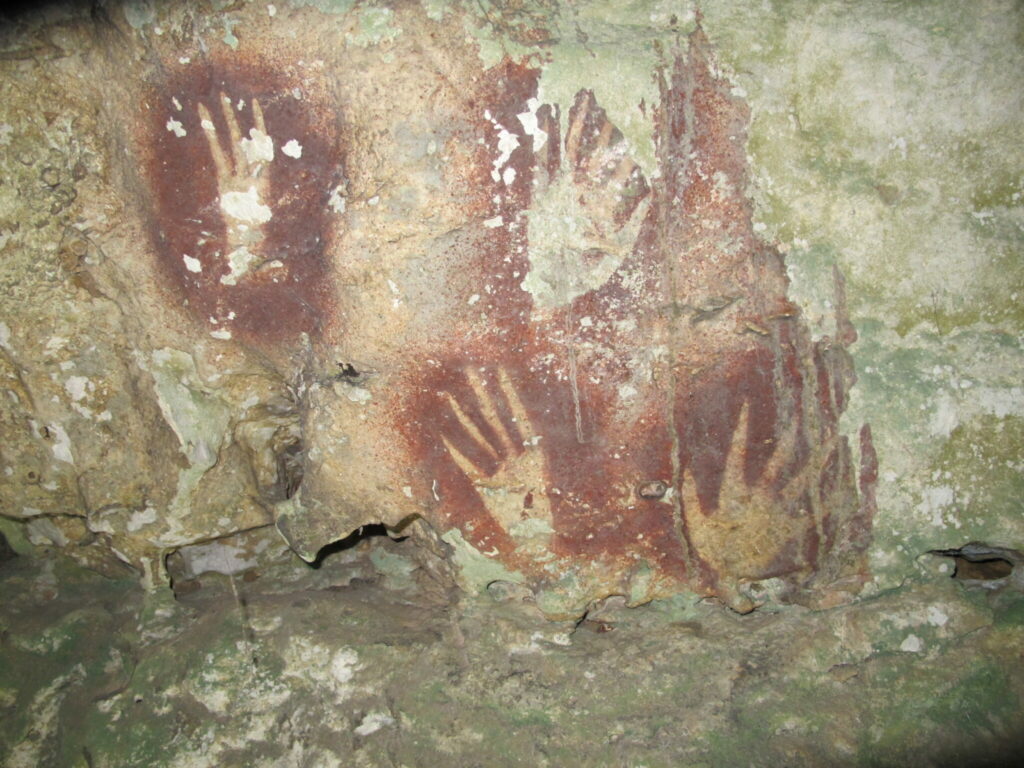
All but one of the sampled hand stencils (n = 6) from Southeast Sulawesi date to the Pleistocene, whereas the remaining paintings mainly consist of motifs with more recent (that is, Holocene) minimum ages (Supplementary Table 1). The oldest minimum-age constraint we obtained is for a hand stencil (sample LMET2) from Liang Metanduno in Muna Island (Fig. 2). This motif is partly covered by ancient coralloid speleothems. This stencil is in a poor state of preservation, comprising only a 14 × 10 cm patch of faded pigment bearing a portion of the fingers and the adjoining palm area. The tip of one finger appears to have been artificially narrowed, either through the additional application of pigment or by moving the hand during pigment application9, a distinct type of hand stencil art thus far identified only in Sulawesi10. Dating results show that this stencil was produced at least 67.8 thousand years ago (ka) (71.6 ± 3.8 ka) (Fig. 3). An additional coralloid speleothem (denoted as LMET1) was sampled over another hand stencil located on the same panel 11 cm to the left of the previous one (Fig. 4). This motif is also partly covered over by ancient coralloid speleothems, with only a portion of the original stencil remaining in the form of a 14 × 9 cm area of sprayed pigment bearing negative impressions of three fingers. The pigment appears darker in colour than the other visible hand stencils on the panel. Sample LMET1 comprises two distinct pigment layers embedded within the calcium carbonate. The stratigraphically oldest pigment layer has a minimum date of 60.9 ka (70.5 ± 9.5 ka), whereas the second pigment layer has a minimum date of 21.5 ka (22.8 ± 1.3 ka) and a maximum date of 32.8 ka (30 ± 2.8 ka). Close inspection shows that the darker pigment overlies the lighter pigment on the visible portion of the image. The lighter pigment may correspond to an earlier hand stencil or represent residual sprayed pigment associated with the hand stencil sampled as LMET2. Alternatively, the lighter layer may be the remains of a different motif, now obscured or no longer visible, that predates the overlying pigment. Regardless, it is evident from LMET1 that two episodes of Pleistocene rock art production on this panel are separated by a period of at least 35 kyr. Finally, as the oldest narrow-fingered stencil previously dated yielded a minimum date of 17 ka (ref. 1), we may conclude that this regionally unique variant of stencil art is much older than previously thought10.
Liang Metanduno also contains paintings that appear to be much younger than the two dated hand stencils, based on the extent of weathering and other observations. These much fresher-looking artworks, executed using a brownish pigment, have been applied over existing speleothems and the ‘new’ cave wall surface exposed by the exfoliation of the older surface bearing the hand stencils, as well as over the dated hand stencils themselves. Among the images, a figurative representation of a bird, probably a chicken (Gallus sp.), measuring 13.5 cm × 12 cm, is located between the two dated hand stencils (Supplementary Information). The depicted subject matter (for example, introduced domestic fauna) attributes these figures to or after the arrival of Austronesian-speaking ‘Neolithic’ societies in the region11,12 (about 4–3.5 ka). At a nearby cave, Gua Pominsa, a similar brown-pigment image showing a human figure possibly holding material culture objects in both hands yielded a minimum date of 3.9 ka (5 ka ± 1.1 ka) (GPOM1) (Extended Data Fig. 1). This figure is possibly the oldest evidence of Austronesian culture identified thus far in the region.
Dating of several other hand stencils from southeastern Sulawesi produced minimum dates falling within the Late Pleistocene epoch. In Gua Mbokita, a limestone cave in the Menui Kepulauan district, two samples provided minimum dates of 44.7 ka (50.8 ± 6.1 ka) (MBK1) and 25.9 ka (31.1 ± 5.2 ka) (MBK2) (Extended Data Fig. 2). Two separate hand stencils from Gua Anawai were also dated to a minimum of 19.1 ka (19.9 ± 0.8 ka) (ANW1) and 20.1 ka (22.1 ± 2.1 ka) (ANW2), respectively (Extended Data Figs. 3 and 4). A maximum date of 20.4 ka was also obtained for ANW1, suggesting that these hand stencils were produced between 20.1 and 20.4 ka and that people were creating them until at least the Last Glacial Maximum.
Further dating results for other motifs, including artworks that are likely to be much younger than these hand stencils (although we only have minimum ages for the former), are reported in Extended Data Figs. 5–9 and Supplementary Table 1.
Implications for early human migration
Our dating investigation in Southeast Sulawesi shows that extremely old rock art is not just concentrated in the Maros-Pangkep district in the southwestern peninsula but occurs in other parts of this large Wallacean island (about 174,000 km2). These findings support the growing view that Sulawesi was host to a vibrant and longstanding artistic culture during the Late Pleistocene epoch10,13. Two artworks we dated in Southeast Sulawesi also have far-reaching implications for our understanding of early human history. With minimum-age constraints of 67.8 ka (71.6 ± 3.8 ka) and 60.9 ka (70.5 ± 9.5 ka), the hand stencils from Liang Metanduno provide the oldest demonstrated minimum-age constraints reported to date worldwide for parietal art that can be attributed to our species. Previously reported evidence for very early rock art in Europe, a region first inhabited by Homo sapiens around 54 ka (ref. 14) (although this remains debated15), includes a sprayed disc with a published minimum date of 40.8 ka (41.4 ± 0.6 ka)16 and a hand stencil from northern Spain (Maltravieso) with a published minimum date of 66.7 ka (70.1 + 3.8–3.4 ka)6. The latter motif has been attributed to Neanderthals, but its dating has been controversial17,18,19,20,21,22,23,24 (Methods, section ‘Interpretation of U-series ages’).
There is no obvious method available to us to determine which human taxon produced the Liang Metanduno stencil (LMET2), and, to further complicate matters, Sulawesi was host to archaic hominins before colonization by modern humans25,26—although it remains unclear whether there was a chronological overlap with our species on the island27. Nevertheless, we attribute the earliest cave art of Muna to H. sapiens based on the added technical and stylistic complexity of the intentionally modified fingers on the hand stencil and the close fit with the known arrival time of our species in the region.
About the latter, the colonization of Sahul by modern humans is now thought to have occurred by at least 68.7–59.3 ka (65.0 ka ± 3.7, 5.7 ka), based on excavated findings at Madjedbebe in northern Australia7. The initial peopling of this continent is widely considered to have involved the first planned, long-distance sea crossing undertaken by our species. The earliest intentional ocean voyages over shorter distances took place when H. sapiens spread beyond the extreme eastern edge of the Eurasian continent (Sunda) and crossed the ‘Wallace Line’, the main biogeographical boundary marking the easternmost limit of the floral and faunal communities of Asia. Modelling data, based on palaeogeographic, environmental and demographic reconstructions, favours two main routes from Sunda to Sahul28,29,30,31,32. The northern route began in present-day Borneo (Sunda) and passed through Sulawesi and from there to Sahul through Misool or the western tip of Papua28. The southern route runs eastwards from Java through the Lesser Sunda Islands to northwestern Australia (through Timor)28 (Fig. 1). Current archaeological evidence demonstrates an early presence of modern humans at the nominal beginning and end points of these routes7,33,34 (Laos by 86–68 ka, Sumatra by 73–63 ka and Australia by 69–59 ka). Although modelling suggests an early dispersal to Sahul through the northern route, possibly with a later (that is, about 45 ka) secondary dispersal along the southern route30,31,35, there has been no archaeological evidence so far to bolster this scenario. A gap of about 15 kyr in modern human sites between Sumatra and Australia and the broader region between them has made it impossible to support any particular migratory pathway to Sahul.
The newly discovered Liang Metanduno hand stencils are the oldest archaeological evidence revealed so far for the presence of our species in Wallacea. Notably, the dated rock art presented here is the easternmost in Wallacea and is located along the northern route to Sahul, as is all of the dated Pleistocene cave art reported thus far from Island Southeast Asia1,2,3,4,5,8. This strongly supports the view that the initial peopling of the Sahul landmass involved maritime journeys through northern Wallacea. It is also evident from our findings that the first modern humans to reach Sahul about 65 ka brought with them a sophisticated artistic culture, with implications for the likely age of early painted rock art sequences in northern Australia36. Given the extreme antiquity of the Liang Metanduno stencil, it seems reasonable to anticipate that evidence for rock art production of a similar age will be present at other locations along the northern route to Sahul.
Implications for early human migration
Our dating investigation in Southeast Sulawesi shows that extremely old rock art is not just concentrated in the Maros-Pangkep district in the southwestern peninsula but occurs in other parts of this large Wallacean island (about 174,000 km2). These findings support the growing view that Sulawesi was host to a vibrant and longstanding artistic culture during the Late Pleistocene epoch10,13. Two artworks we dated in Southeast Sulawesi also have far-reaching implications for our understanding of early human history. With minimum-age constraints of 67.8 ka (71.6 ± 3.8 ka) and 60.9 ka (70.5 ± 9.5 ka), the hand stencils from Liang Metanduno provide the oldest demonstrated minimum-age constraints reported to date worldwide for parietal art that can be attributed to our species. Previously reported evidence for very early rock art in Europe, a region first inhabited by Homo sapiens around 54 ka (ref. 14) (although this remains debated15), includes a sprayed disc with a published minimum date of 40.8 ka (41.4 ± 0.6 ka)16 and a hand stencil from northern Spain (Maltravieso) with a published minimum date of 66.7 ka (70.1 + 3.8–3.4 ka)6. The latter motif has been attributed to Neanderthals, but its dating has been controversial17,18,19,20,21,22,23,24 (Methods, section ‘Interpretation of U-series ages’).
There is no obvious method available to us to determine which human taxon produced the Liang Metanduno stencil (LMET2), and, to further complicate matters, Sulawesi was host to archaic hominins before colonization by modern humans25,26—although it remains unclear whether there was a chronological overlap with our species on the island27. Nevertheless, we attribute the earliest cave art of Muna to H. sapiens based on the added technical and stylistic complexity of the intentionally modified fingers on the hand stencil and the close fit with the known arrival time of our species in the region.
About the latter, the colonization of Sahul by modern humans is now thought to have occurred by at least 68.7–59.3 ka (65.0 ka ± 3.7, 5.7 ka), based on excavated findings at Madjedbebe in northern Australia7. The initial peopling of this continent is widely considered to have involved the first planned, long-distance sea crossing undertaken by our species. The earliest intentional ocean voyages over shorter distances took place when H. sapiens spread beyond the extreme eastern edge of the Eurasian continent (Sunda) and crossed the ‘Wallace Line’, the main biogeographical boundary marking the easternmost limit of the floral and faunal communities of Asia. Modelling data, based on palaeogeographic, environmental and demographic reconstructions, favours two main routes from Sunda to Sahul28,29,30,31,32. The northern route began in present-day Borneo (Sunda) and passed through Sulawesi and from there to Sahul through Misool or the western tip of Papua28. The southern route runs eastwards from Java through the Lesser Sunda Islands to northwestern Australia (through Timor)28 (Fig. 1). Current archaeological evidence demonstrates an early presence of modern humans at the nominal beginning and end points of these routes7,33,34 (Laos by 86–68 ka, Sumatra by 73–63 ka and Australia by 69–59 ka). Although modelling suggests an early dispersal to Sahul through the northern route, possibly with a later (that is, about 45 ka) secondary dispersal along the southern route30,31,35, there has been no archaeological evidence so far to bolster this scenario. A gap of about 15 kyr in modern human sites between Sumatra and Australia and the broader region between them has made it impossible to support any particular migratory pathway to Sahul.
The newly discovered Liang Metanduno hand stencils are the oldest archaeological evidence revealed so far for the presence of our species in Wallacea. Notably, the dated rock art presented here is the easternmost in Wallacea and is located along the northern route to Sahul, as is all of the dated Pleistocene cave art reported thus far from Island Southeast Asia1,2,3,4,5,8. This strongly supports the view that the initial peopling of the Sahul landmass involved maritime journeys through northern Wallacea. It is also evident from our findings that the first modern humans to reach Sahul about 65 ka brought with them a sophisticated artistic culture, with implications for the likely age of early painted rock art sequences in northern Australia36. Given the extreme antiquity of the Liang Metanduno stencil, it seems reasonable to anticipate that evidence for rock art production of a similar age will be present at other locations along the northern route to Sahul.