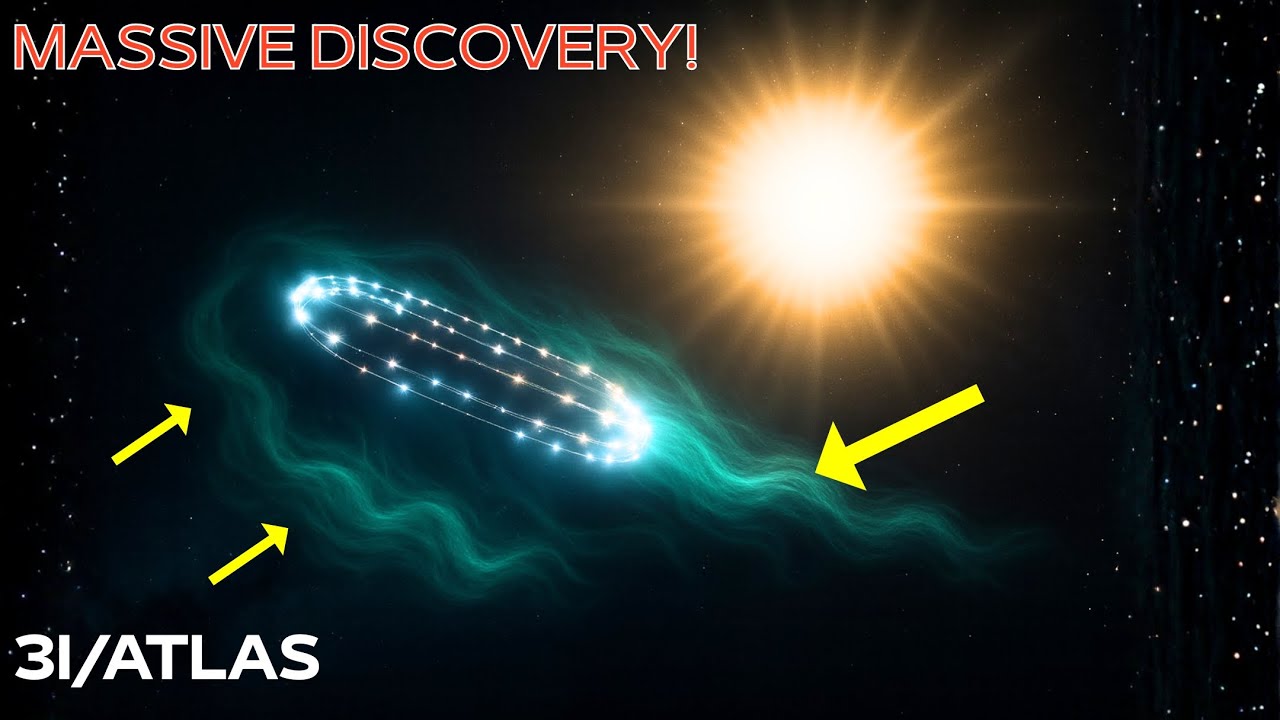
For the first time, astronomers have detected unusually high levels of methanol in the interstellar comet 3I/ATLAS, a visitor that formed around another star and has been traveling through space for hundreds of millions of years. New observations from ALMA reveal a chemical profile unlike anything seen in comets from our own solar system.
In this exploration, we’ll dive into what scientists discovered, why it matters, and what it reveals about the chemistry of other star systems. Let’s begin.
Astronomers started observing 3I/ATLAS as soon as its trajectory confirmed it originated from beyond the solar system. Its high speed and open hyperbolic orbit meant it was not bound to the Sun, placing it among the extremely rare class of interstellar objects.
From the start, it behaved differently from typical comets. It released gas earlier and farther from the Sun than expected, suggesting its surface had been dormant for a very long time before entering our region of space.
To probe the comet’s chemistry, researchers used the Atacama Large Millimeter/submillimeter Array (ALMA), one of the most sensitive instruments for detecting molecules in space. By analyzing the light spectrum from the comet’s coma—the surrounding gas and dust envelope—the team identified two unexpected features: strong hydrogen cyanide signals emerging close to the nucleus and an even more striking abundance of methanol spread throughout the surrounding gas cloud.
This finding immediately captured attention because, while methanol is present in solar system comets, it rarely appears in such high concentrations. In 3I/ATLAS, methanol represents a significantly larger fraction of the released vapor—far above levels commonly measured in comets born near the Sun.
The molecule’s distribution also differs. Instead of being released strictly from the nucleus, methanol appears to be produced or liberated across a wider area in the coma. This suggests secondary processes, such as the breakup of icy grains or chemical reactions triggered as sunlight interacts with surrounding material.
Another key observation is the contrasting behavior of methanol and hydrogen cyanide. Hydrogen cyanide seems tightly linked to the solid nucleus, sublimating directly from its surface as the comet warms. Methanol, however, shows a broader emission pattern, implying it may exist in multiple forms—frozen within various layers of the comet, embedded in dust particles, or produced through reactions as the coma evolves.
This contrasting behavior is one of the strongest signs that the comet’s internal structure is compositionally diverse.
Beyond spectroscopy, earlier observations showed that the comet’s reflected light appears slightly redder than typical solar system comets. This red coloration supports the idea that its surface chemistry has been shaped by different environmental conditions, either during formation or during long exposure to interstellar radiation.
Taken together, these findings paint a clear picture: 3I/ATLAS is a chemically unique object carrying materials that likely formed under conditions markedly different from those in the early solar system. For scientists, this makes the comet an invaluable opportunity to study the chemical diversity of planet-forming environments across the galaxy.
Methanol is noteworthy not only for its high abundance but also for what it signifies about chemical evolution. As a simple organic molecule, it plays a central role in pathways leading to more complex chemistry. In laboratory experiments and astrophysical models, methanol often serves as an intermediate step in producing a variety of carbon-based compounds. Its presence in an interstellar comet is thus important for understanding how organic chemistry unfolds in environments far from the Sun.
The unusual concentration of methanol in 3I/ATLAS suggests several possible formation scenarios. One is that the comet originated in a region of its home star system rich in carbon monoxide and other volatile ices. Under cold conditions, these ices can react on grain surfaces to form methanol efficiently. If formed in such an environment, it would naturally contain higher methanol content than comets from our solar system, which formed under different temperature and radiation conditions.
Another theory proposes that the comet may contain significant amounts of iron-bearing minerals. Some researchers suggest that when water interacts with such minerals under heat, methanol can form as a byproduct. If this process occurred in the early history of 3I/ATLAS, it might explain both the presence and distribution of methanol in the coma. This would imply the comet’s interior includes a mixture of metals and ices not commonly found together in solar system comets, further highlighting the diversity of planetary systems.
The comet’s behavior also aligns with theories about long-term interstellar processing. A comet traveling for millions or billions of years through interstellar space encounters cosmic rays that can slowly alter its outer layers. These processed layers may behave differently when heated, releasing certain molecules more readily or breaking down into new compounds. This could explain why the comet began outgassing earlier than expected and why methanol release appears distributed across the coma rather than concentrated at the nucleus.
These interpretations converge on a consistent message: 3I/ATLAS is chemically distinct because it formed under conditions unlike those in our solar system. Its internal structure, molecular inventory, and outgassing behavior provide clues about the diversity of materials that can emerge in other planetary systems.
The detection of abundant methanol in an interstellar comet broadens our understanding of organic chemistry beyond the solar system. Although methanol itself is not biological, it serves as a building block for more complex chemistry. Its presence indicates that pathways toward molecular complexity can occur in environments far from Earth, reinforcing the idea that chemically rich materials may be widespread in the galaxy.
This does not imply life, but it strengthens the hypothesis that the raw chemical ingredients necessary for complex organic processes may be common.
The uniqueness of 3I/ATLAS also challenges assumptions about comet chemistry. Most of what we know about comets comes from those formed in our local region of space. Interstellar comets offer a rare chance to test whether patterns observed here apply elsewhere. The composition of 3I/ATLAS suggests that planetary systems across the galaxy may host a much wider range of chemical environments than previously understood. This has implications not only for comet formation but also for the early stages of planet formation, where ices and dust grains serve as foundational materials.
From a research perspective, the comet underscores the importance of continued monitoring of interstellar objects. Each one passing through the solar system offers a limited observation window. As long as 3I/ATLAS remains visible, astronomers will use radio, optical, and infrared instruments to track how its chemical profile evolves. This will help determine whether its methanol-rich composition is stable or changes under solar heating.
The discovery also revives discussions about potential missions to intercept or study interstellar comets directly. Though challenging, such missions could collect samples untouched by processes that shape solar system bodies. Sampling an interstellar comet would offer unprecedented insight into materials forged in another star’s protoplanetary disk—a scientific opportunity unmatched by any current mission.
Ultimately, 3I/ATLAS serves as a reminder that our solar system is not chemically representative of everything in the galaxy. Interstellar visitors carry records of environments we cannot observe directly, and each one adds a new layer to our understanding of how planetary systems form, evolve, and generate the ingredients that may one day lead to complex chemistry elsewhere.
3I/ATLAS reveals chemistry shaped far beyond our solar system. Its methanol-rich signature challenges what we expect from comets. Each interstellar visitor expands our understanding of planetary diversity.