A Colossal Craft in the Sky? Revisiting Baba Vanga’s Most Unsettling Prophecy
For decades, her name has hovered at the edge of prophecy and controversy, whispered whenever the future feels suddenly uncertain.
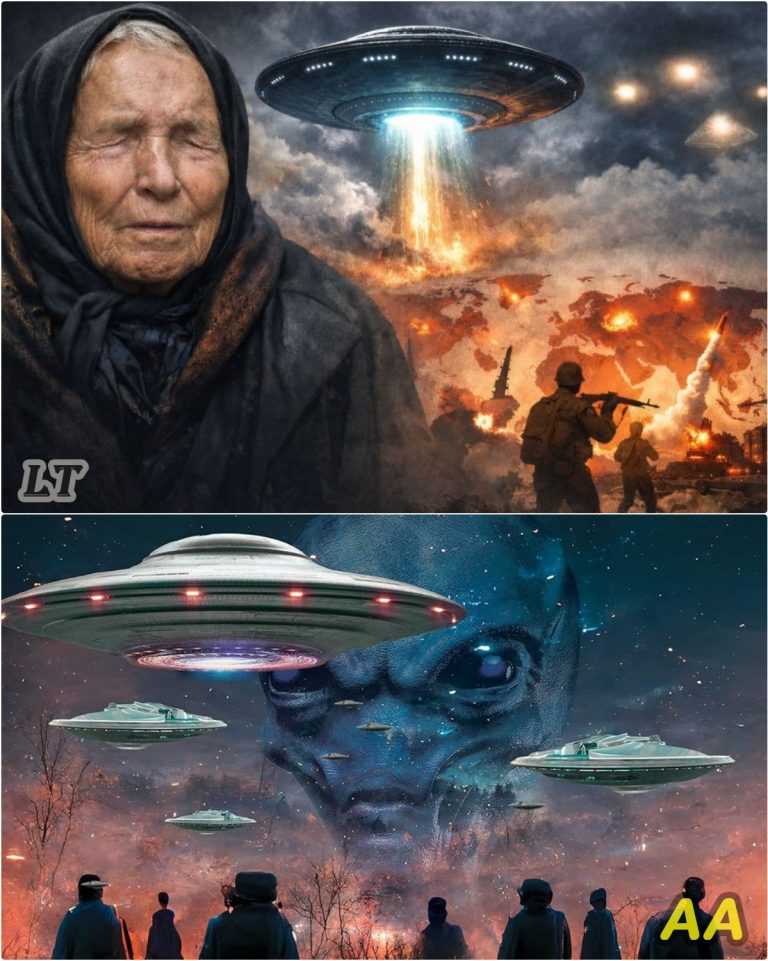
The blind Bulgarian mystic Baba Vanga, who died in 1996 at the age of 85, is once again at the center of global attention—this time because of a chilling prediction tied to a date that is no longer distant.
November 2026.
According to accounts attributed to her, that is when humanity would experience its first confirmed encounter with extraterrestrial life.
Baba Vanga, born Vangeliya Pandeva Gushterova, spent most of her life in relative obscurity in rural Bulgaria.
Blind from childhood, she claimed to perceive visions beyond the physical world, offering cryptic predictions to villagers, politicians, and foreign visitors alike.
After her death, collections of her prophecies spread across Eastern Europe and later the world, translated, retold, and debated endlessly.
Critics argue they were vague, selectively remembered, or retrofitted to events after the fact.
Yet one prediction stands apart for its specificity.
According to multiple sources that claim to preserve her words, Baba Vanga warned that humanity’s first true contact with extraterrestrial intelligence would occur in November 2026.
Not through radio signals.
Not through distant lights or ambiguous sightings.
But through the arrival of a colossal alien spacecraft entering Earth’s atmosphere.
She did not describe its origin.
She did not explain how it would be detected.
And most unsettling of all, she offered no clarity about the visitors’ intentions.
That silence is what has fueled fear.
Unlike many end-times prophecies associated with Baba Vanga, this one does not frame the event as immediate destruction.
There is no mention of invasion, annihilation, or salvation.
Instead, the language attributed to her suggests inevitability.
A meeting that cannot be prevented.
A moment humanity will not control.
The absence of intent—no reassurance, no warning—has left room for every imaginable interpretation.
As November 2026 draws closer, the prophecy has resurfaced against a backdrop that feels uncomfortably aligned with it.
Governments around the world have become more open about unidentified aerial phenomena.
Military agencies have acknowledged encounters with objects that defy conventional explanations.
Scientists openly discuss the possibility of microbial life beyond Earth, while private companies race toward space at unprecedented speed.
What once sounded like science fiction now occupies serious policy discussions.
That convergence has given the old prediction new weight.
Skeptics are quick to point out that Baba Vanga left no written records herself.
Most of her prophecies were passed down orally, documented by followers, relatives, or later authors.
Over time, details may have shifted.
Dates may have been sharpened.
Meanings may have evolved.
In this view, the 2026 prediction is less a precise forecast and more a reflection of humanity’s enduring obsession with the unknown.
But believers counter with a familiar argument.
Baba Vanga was said to have predicted major world events long before they occurred—geopolitical upheavals, disasters, even technological changes.
To them, dismissing the extraterrestrial prophecy outright ignores a pattern they believe has repeated too many times to be coincidence.
What makes this particular warning especially disturbing is its scale.
A “colossal” spacecraft entering Earth’s atmosphere implies visibility.
Global awareness.
No room for denial or secrecy.
It suggests a moment when every nation, every government, and every belief system would be forced to respond at once.
The world would not discover extraterrestrial life gradually.
It would confront it suddenly.
Experts urge caution.
Historians of prophecy note that predictions often gain power as dates approach, not because they become more accurate, but because uncertainty amplifies anxiety.
Psychologists point out that in times of rapid technological and social change, apocalyptic or transformative prophecies tend to resurface, offering a narrative to contain fear.
In that sense, Baba Vanga’s prediction may say more about us than about the future.
Still, even scientists admit something unusual: if first contact were to occur, it would likely be disruptive in ways no model can fully predict.
Cultural shock, political instability, religious upheaval, and existential questioning would ripple across the globe.
The idea that such a moment could arrive without explanation, without warning, and without known intent is deeply unsettling—prophecy or not.
Baba Vanga’s warning does not describe panic in the streets or cities in flames.
Instead, it hints at a pause.
A moment when humanity realizes it is no longer alone in a way that cannot be debated away.
That ambiguity is precisely what keeps the story alive.
It is not a disaster movie ending.
It is an unanswered question hanging in the air.
As November 2026 approaches, interest in the prediction continues to grow.
Online forums dissect every rumored UFO sighting.
Old interviews are retranslated.
New interpretations emerge weekly.
Some see the prophecy as symbolic—a metaphor for humanity confronting the unknown, whether through artificial intelligence, space exploration, or its own technological creations.
Others take it literally, watching the skies with a mix of curiosity and dread.
Whether Baba Vanga truly foresaw extraterrestrial contact or whether her words have been shaped by decades of retelling, one thing is certain.
The prediction has tapped into a deep, shared anxiety about our place in the universe.
About what happens when the idea of “alone” finally disappears.
If November 2026 passes quietly, the prophecy will likely fade, absorbed into the long list of unfulfilled predictions.
But if something unexpected happens—something that challenges our understanding of reality—her name will return instantly, spoken with awe rather than skepticism.
Until then, the warning remains suspended between belief and doubt.
A blind mystic’s vision echoing into a future that has not yet decided whether it will listen.